Boards today are asking more of management than ever before. In an environment shaped by disruption, artificial intelligence, capital volatility, geopolitical uncertainty, and heightened stakeholder expectations, management teams are increasingly expected to pivot quickly, reallocate resources decisively, and move away from strategies that are no longer aligned with long-term value creation.
Yet many executive compensation approaches reflect a different operating model.
For many, incentive plans still reward performance against targets set at the start of the performance period and evaluated only after the fact. While this approach provides structure and discipline, it can also create a disconnect between what Boards expect from management and what they actually reward. This gap is most visible in short-term incentives, given they tend to prioritize sticking to a fixed plan rather than adapting to new circumstances.
As a result, Boards may emphasize the need for agility, but compensation structures continue to reward adherence to static goals instead of responsiveness to change.
This tension is becoming harder to ignore. As annual target setting becomes more difficult amid rising economic and geopolitical uncertainty, incentive design and governance can no longer remain static.
The question for Boards is not whether rigour and accountability still matter. They do. The question is whether the current approach to executive compensation is sufficiently equipped to reward the behaviours that long-term value creation increasingly requires: good judgment under uncertainty, willingness to pivot, disciplined capital reallocation, and the ability to distinguish between staying the course and knowing when to change it.
The growing mismatch between strategy and incentives
Traditional incentive frameworks are typically built around quantifiable financial and operational objectives: earnings growth, return on capital, revenue delivery, TSR, or strategic milestones established early in the year. These measures remain important, and in many cases essential, but they do not always capture adaptability.
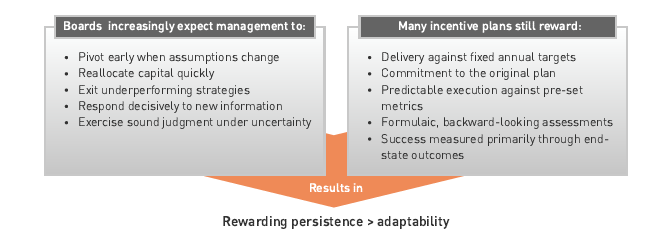
Boards should therefore ask a simple but powerful question: Are we rewarding the performance we say we want, or the one that is easiest to measure?
Why the problem persists
If the misalignment is increasingly evident, why is it so difficult to address? One reason is that compensation governance is, by design, cautious. In practice, that caution often shows up as:
Process-heavy decision making
Annual cycles, fixed scorecards, and backward-looking assessments can leave little room to reflect and address changing conditions.
Limited room for judgment
Even when operating conditions shift materially, Boards may hesitate to revisit outcomes, particularly if overall corporate performance and shareholder experience are poor.
Benchmark-led design
Peer norms often provide comfort and defensibility, but may reinforce conformity over strategic differentiation.
Risk aversion
Boards remain mindful of proxy advisor expectations, shareholder scrutiny, and disclosure optics.
These issues are understandable. Executive pay remains highly visible and often contentious. Boards want decisions to be objective and supportable, and ultimately for a public company the shareholder experience must be considered. But together, these dynamics can create a structural barrier to agility – even when the Board recognizes that adaptability is essential.
In other words, this is not only a pay design issue. It is also a governance issue.
What boards do in practice when conditions change
Periods of disruption often reveal what Boards already know; sometimes you cannot get to the right answer without applying judgment. Agile Boards apply judgment, adjust outcomes and exercise discretion. They ask whether formulaic results truly reflect performance and provide rationale for their decisions, often after the fact. The debate over whether discretion should be used is over. It already exists, and Boards rely on it. What matters now is whether it is applied deliberately, or left to reaction.
What more agile compensation design can look like
An agile approach to compensation does not mean abandoning metrics, lowering standards, or rewriting plans every quarter. Nor does it mean replacing structure with subjectivity. It means designing incentive systems that reflect how performance is defined and assessing that performance in a future that is less certain than the past.
There are a few practical ways Boards can advance this:
From rewarding outcomes alone to rewarding adaptability
Boards can broaden the performance conversation beyond what was achieved to include how leadership responded as circumstances evolved. That may involve recognizing:
-
Speed and quality of strategic decision-making
-
Effective communication and engagement with the Board
-
Disciplined capital reallocation
-
Willingness to exit or reshape initiatives when facts change
-
Transparency around trade-offs and risks
Designing incentive plans with principled flexibility
Boards can be intentional and transparent about where flexibility exists and how it is exercised, including:
-
Use of qualitative/strategic measures
-
Structured use of discretion through predetermined discretion principles
-
Clear, proactive disclosure of the Board’s approach to applying discretion
Long-term performance orientation
Near‑term pivots may pressure short‑term results but are intended to strengthen long‑term performance and enterprise value. The Board’s role is to keep performance assessment and incentives anchored in this longer‑term perspective. Key considerations include:
-
Does the pivot clearly support long‑term strategy, resilience, and competitive position, despite near‑term impact?
-
Should longer‑term incentive structures be used to better align compensation with truly long-term performance outcomes?
From reactive to intentional discretion
For Boards that are already exercising discretion, the next step may be to develop guiding principles to ensure consistent application.
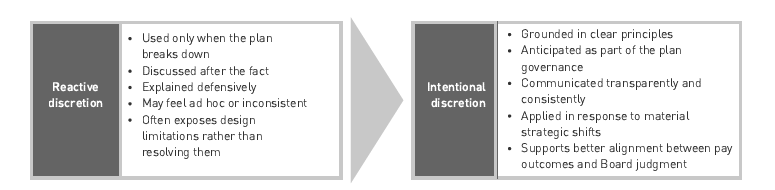
Building agility into incentive plans does not mean excusing underperformance. Rather, it requires careful governance to ensure judgment is applied consistently and in response to genuine shifts in the operating environment and strategy, not as a reaction to poor results. Boards should also be mindful not to apply judgment prematurely; while timely intervention can signal strong governance, it is equally important to avoid exercising discretion multiple times, and in some cases it may be more effective to reserve judgment until there is a clearer view of the overall outcome. In deciding whether to apply discretion, Boards may ask: if the fact set were reversed, would we adjust the outcome in the opposite direction?
How does a Board become more agile?
If Board mandates are too rigid, or process is prioritized over substance, compensation oversight may struggle to keep pace with an evolving strategy. This is where board effectiveness reviews can be particularly valuable — not as a compliance exercise, but as a practical governance tool to enable Boards to stop, stand back, reflect and pivot if required.
A practical board effectiveness review can help directors ask:
What’s working well?
Which governance practices are supporting timely, high-quality compensation decisions?
What’s not working?
Where are the rigid processes slowing decision-making or limiting the Board’s ability to apply sound judgment?
What is excess process?
Where has the Board over-indexed on process in ways that burden management without improving oversight?
What needs to change?
What adjustments to cadence, delegated authority, information flow or committee practices would improve agility?
For compensation committees specifically, this may mean revisiting annual rhythms, increasing interim discussions on performance, improving access to real-time information, and clarifying where judgment decisions should sit. In some cases, relatively modest changes in ways of working can materially improve decision-making.
The key is practicality. Board effectiveness is most useful when it helps Boards define tangible ways of working that better support the decisions they need to make.
Questions Boards should be asking now
As Boards and compensation committees reflect on their own frameworks, a few questions may be especially useful:
-
Where does rigidity in our incentive design no longer reflect the strategic realities of the business?
-
Are we using discretion only when forced to, or have we articulated how judgment should be exercised?
-
Do our incentives distinguish between volatility and adaptability?
-
Are we rewarding management for disciplined course correction to improve long-term outcomes, or only for delivering the original plan?
-
And are our own Board processes agile enough to oversee compensation in a changing strategic context?
Discipline in a world of change
Incentivizing adaptability doesn’t mean sacrificing discipline, rigour, or a focus on long-term value, nor does it mean abandoning target setting altogether. While setting meaningful targets has become more difficult in today’s environment, that’s not a reason to avoid it. Boards and shareholders approve a strategy and reasonably expect management to show persistence in executing it, even as conditions change. At the same time, Boards recognize that strategy is not just about setting direction but knowing when to adjust it. Compensation should reflect that reality. In an environment where management is expected to learn quickly, act decisively, and respond to shifting conditions, Boards must make it clear that course correction is a sign of strength, not failure.
As operating environments shift faster than pay cycles, compensation design, and the governance around it, must keep up.